Guide
Laser Hair Removal for PCOS: Does It Work? Sessions & Tips
Laser works for PCOS hair, but expect more sessions and touch-ups. What studies show, sessions needed, cost, side effects, and tips for better results.
By PCOS Polly ·

Key takeaways
- Laser does reduce PCOS hair, but less completely than in people without PCOS: studies report roughly a 30-50% drop in hair count or severity, with removal time falling from about 2 hours a week to 20 minutes.
- Plan on 8-12 sessions rather than the usual 6, then touch-ups every few months, because androgens keep waking up new follicles.
- Laser plus a medication that lowers androgens (combined pill, spironolactone, or metformin) works better than laser alone.
- Alexandrite and diode lasers have the best PCOS data; Nd:YAG is the safer choice for darker skin.
- Laser cannot treat blonde, grey, or red hair; electrolysis can.
Yes, laser hair removal works for PCOS, but expect more sessions and ongoing touch-ups. Studies in women with PCOS show roughly a 30-50% reduction in hair count or severity after a full course, and time spent removing hair can drop from about 2 hours a week to 20 minutes. Because high androgens keep creating new hair, plan on 8-12 sessions instead of the usual 6, then maintenance every few months. Pairing laser with an androgen-lowering medication gives the best results.
What the PCOS studies actually show
| Study | Who | Result |
|---|---|---|
| Randomized trial, British Journal of Dermatology 2005 | 88 women with facial hirsutism, mostly PCOS, 5 high-fluence sessions | Severity score fell from 7.3 to 3.6; weekly hair-removal time fell from 112 to 21 minutes; quality of life and anxiety improved |
| Alexandrite study, JPRAS 2007 | 60 women with PCOS | 31% fewer hairs after 6 treatments; hair-free interval grew from 1.9 to 4.3 weeks by 10 treatments; 95% satisfied |
| Systematic review, JAMA Dermatology 2024 | 6 studies, 423 people with PCOS | Alexandrite beat IPL; diode laser plus metformin or the pill beat laser alone; overall evidence certainty low |
The 2024 review fed into the 2023 international PCOS guideline, which now lists laser and light therapies as options for facial hirsutism and notes that more treatments may be needed with PCOS.
The honest summary from all three: laser reliably thins and slows PCOS hair and makes daily life much easier. “Never shave again” is rare.
Why PCOS hair is harder to laser
Laser heats the pigment in a growing hair and damages its follicle. In PCOS, higher androgens (testosterone and related hormones) keep converting fine, light vellus hairs into dark terminal hairs. Those new hairs were not there to be treated in session one. That is why:
- Results plateau around session 6 for many people
- Chin and jaw (the most androgen-sensitive areas) respond slowest
- Stopping hormonal treatment can bring hair back faster
What people in r/PCOS consistently report matches the studies: “It never fully went away, but I went from tweezing daily to once a week” is the typical success story.
How many sessions and how often
| Area | Typical PCOS course | Spacing | Maintenance |
|---|---|---|---|
| Upper lip, chin, jaw, neck | 8-12 sessions | Every 4-6 weeks | Every 2-6 months |
| Underarms, bikini, legs | 6-10 sessions | Every 6-8 weeks | Once or twice a year |
| Chest, abdomen, back | 8-12 sessions | Every 6-8 weeks | Every 3-6 months |
Facial hair cycles faster than body hair, so the face is treated more often.
Which laser is best for PCOS hair
| Laser | Best for | Notes |
|---|---|---|
| Alexandrite (755 nm) | Light to light-olive skin (Fitzpatrick I-III), dark hair | Strongest PCOS data |
| Diode (800-810 nm) | Light to medium-brown skin (I-IV) | Good PCOS data, especially paired with medication |
| Nd:YAG (1064 nm) | Darker skin (IV-VI) | Safest for deep skin tones; may need more sessions |
| IPL (not a true laser) | Light skin, dark hair | Underperformed alexandrite in PCOS studies |
Ask the clinic which device they use and whether it suits your skin type. Clinics that only offer IPL are a weaker choice for PCOS facial hair.
Laser plus medication beats laser alone
Laser removes existing hair; medication slows what grows next. The combinations with the best evidence:
- Combined oral contraceptive pill: lowers free testosterone; often the first-line pairing
- Spironolactone: blocks androgen effects; takes 6-9 months to show (spironolactone for PCOS)
- Metformin: studied with diode laser and helped results in PCOS, likely by lowering insulin-driven androgens (PCOS insulin resistance)
- Eflornithine cream: slows facial regrowth between sessions
Supplements like inositol and spearmint tea have small studies on androgens; see inositol for PCOS for realistic timelines.
Side effects and paradoxical hair growth
Common and short-lived: redness, swelling around follicles, and a stinging “rubber band snap” feeling for a day or two.
Less common: blistering, darkening or lightening of the skin, especially with the wrong laser for your skin type or recent sun exposure.
Paradoxical hypertrichosis is new, finer hair growing near the treated area. A meta-analysis put it around 3% overall, mostly on the face and neck. A 2025 prospective study found it more often in people with PCOS (about 33% vs 14%) and in medium skin tones (Fitzpatrick III-IV), and daily sunscreen was protective. If hair seems to be increasing after laser, tell your provider before the next session; settings or devices can be changed.
Cost
Prices vary widely by city and area. The American Society of Plastic Surgeons’ latest average for laser skin treatments, including hair removal, is about $700 per treatment, but small facial areas like the lip and chin usually cost far less than large body areas. Because PCOS courses run longer, ask about packages that include extra sessions or discounted touch-ups, and check whether your clinician can document hirsutism, since a few insurance plans cover treatment when a medical condition is the cause.
How to get better results
- Shave, don’t wax or tweeze, for 4-6 weeks before sessions. Laser needs the root in place.
- Stay out of the sun and skip self-tanner for 2 weeks before and after.
- Keep a steady schedule. Gaps longer than 8 weeks on the face waste progress.
- Get your hormones checked first. Untreated high androgens are the main reason laser stalls (how PCOS is diagnosed).
- Track it. Log session dates and how many days you go between removals. That number is your real progress meter.
- Know when to switch. Blonde, grey, or red hairs, or paradoxical regrowth, need electrolysis (see electrolysis for PCOS facial hair; PCOS facial hair compares every option).
Track your progress in PCOS Polly
Hair changes are slow, and it’s easy to feel like nothing is working at session five. In PCOS Polly you can log each laser session, medication start dates, and a weekly “days between removals” note, then look back at the trend over months instead of trusting the mirror. Try it free for 7 days.
Download PCOS Polly on the App Store →
Sources
- Clayton WJ et al. A randomized controlled trial of laser treatment among hirsute women with polycystic ovary syndrome. British Journal of Dermatology, 2005.
- McGill DJ et al. Laser hair removal in women with polycystic ovary syndrome. Journal of Plastic, Reconstructive & Aesthetic Surgery, 2007.
- Tan et al. Laser and Light-Based Therapies for Hirsutism Management in Women With Polycystic Ovarian Syndrome. JAMA Dermatology, 2024.
- Qeyam et al. Predictors and prevalence of paradoxical hypertrichosis in alexandrite laser-based facial hair removal: a prospective clinical study. Lasers in Medical Science, 2025.
- Teede HJ et al. Recommendations from the 2023 International Evidence-based Guideline for the Assessment and Management of PCOS. Fertility and Sterility, 2023.
- American Society of Plastic Surgeons. How much does laser hair removal cost?
Frequently asked questions
How many laser sessions do you need with PCOS? +
Most people with PCOS need 8-12 sessions spaced 4-8 weeks apart for the face, compared with about 6 for people without hormonal hair growth, then maintenance sessions every 2-6 months.
Is laser hair removal permanent with PCOS? +
It is long-term reduction, not guaranteed permanent removal. Treated follicles stay weaker, but high androgens can activate new ones, so most people with PCOS need occasional touch-ups for years.
Can laser hair removal make PCOS hair worse? +
Rarely, laser can trigger paradoxical hypertrichosis, new finer hair growth near the treated area, usually on the face or neck. Studies report it in about 3% of patients overall and more often in people with PCOS and medium skin tones. Tell your provider right away if hair seems to be increasing.
Why is laser not working on my PCOS chin hair? +
Common reasons are too few sessions, sessions spaced too far apart, low settings, hair that is too light for laser, or untreated high androgens creating new hair. Ask about a higher-fluence alexandrite or diode device and whether hormonal treatment could help.
Can I get laser hair removal while taking spironolactone or birth control? +
Yes, and combining them is what guidelines and studies favor. Tell your provider about every medication, especially anything that increases sun sensitivity, and avoid laser while pregnant.
Keep reading
All articles →-
 Guide
Electrolysis for PCOS Facial Hair: Sessions, Results & Tips
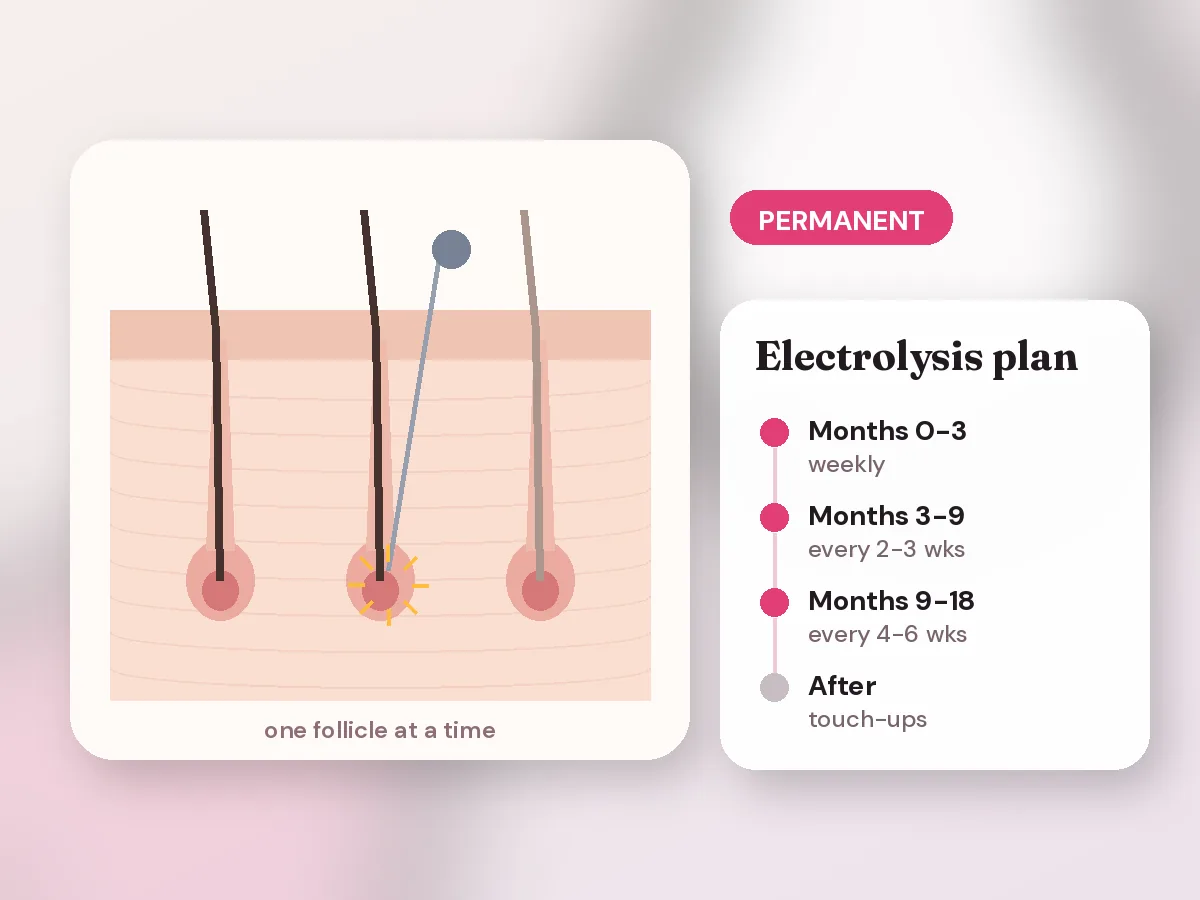
Electrolysis is the only permanent removal for PCOS chin and lip hair: sessions needed, electrolysis vs laser, pain, aftercare, and finding a pro.
Read article -
 Guide
PCOS Facial Hair Removal: Best Methods Ranked (Chin & Lip)
PCOS hair removal methods ranked: laser, electrolysis, eflornithine, and at-home options for chin and lip hair, plus the hormonal layer that stops regrowth.
Read article -
 Guide
Getting Pregnant With PCOS: Timing, Odds & When to Get Help
Many people with PCOS conceive. How to time sex around real fertility signs with irregular cycles, lifestyle and medical options, and when to get help.
Read article